Skip to content

CategoryFilm Festivals

Slamdance: Memphis ’69

“But the music prevailed…”

Directed by Joe LaMattina, Memphis ’69 is a new documentary that serves as a time capsule for the 1969 Memphis Birthday Blues Festival held on the 150th anniversary of the city’s founding. Made up almost entirely of archival footage from the three day festival, a few title cards at the beginning give the film some context. The festival ran from 1965 to 1969 during a time of much racial strife in the city. It was one year after the Martin Luther King Jr.’s assassination and the KKK held a rally in the city concurrent with the event.

The folk and blues revival of the 1960s helped launch new stars of the genre but also allowed for the rediscovery of older blues performers. A wide range of blues, folk, country and even gospel musicians performed on stage for a motley crew of attendees. The attendance fluctuated throughout the three days but it never put a damper on the spirits of the musicians who played their hearts out. 

Memphis ’69 takes viewers on a time travel trip to this one-of-a-kind blues festival. It lingers over many of the performances and also captures the spirit of the time. All of the performers featured in the documentary are long gone and this film now serves as a tribute to them.

Performers featured in Memphis ’69 include:

  • Rufus Thomas
  • Bukka White
  • Nathan Beauregard (106 year old, blind performer)
  • Sleepy John Estes
  • Yank Rachell
  • Jo Ann Kelly
  • “Backwards” Sam Firk
  • Son Thomas
  • Lum Guffin
  • Rev. Robert Wilkins & Family
  • John Fahey
  • Sid Selvidge
  • Molloch
  • John D. Loudermilk
  • Furry Lewis
  • Piano Red
  • Jefferson Street Jug Band
  • The Insect Trust
  • Johnny Winter
  • The Salem Harmonizers
  • Mississippi Fred McDowell

Memphis ’69 was screened at Slamdance 25 and is nominated for a Grand Jury Prize for Best Documentary Feature.

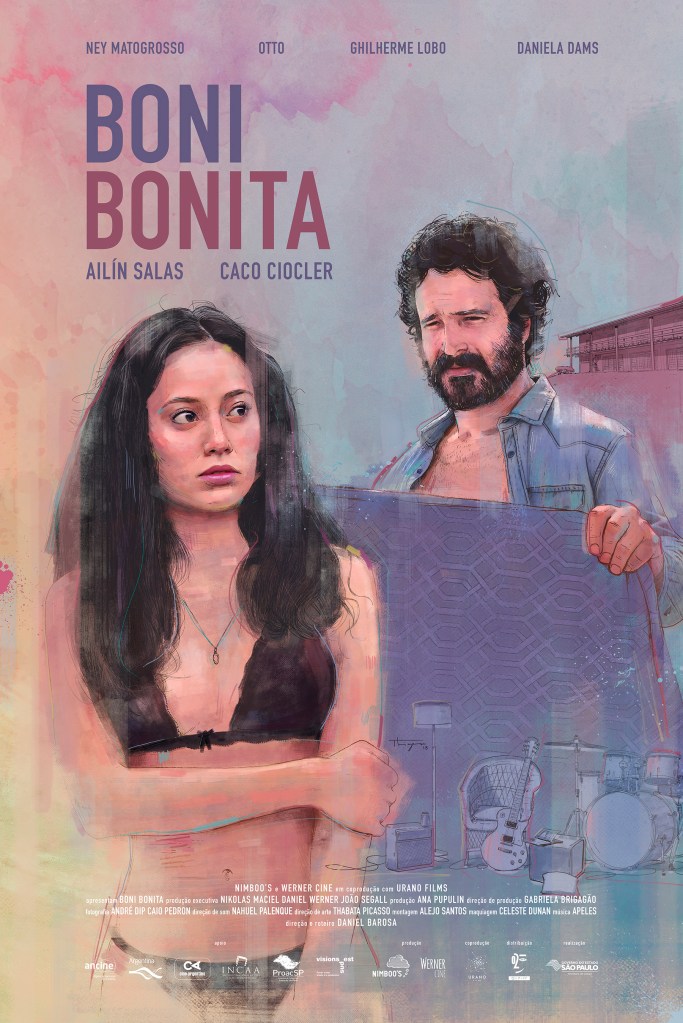
Slamdance: Boni Bonita

Boni Bonita, directed by Daniel Barosa, is a Brazilian-Argentine film, mostly in Portuguese, about a rebellious young woman and an aging musician. The story takes place over nine years, starting in 2007 and ending in 2016, and follows Beatriz (Ailin Salas) as she struggles with the loss of her mother, her complicated relationship with her father, self-harm and the musician who seems just out of her reach. Rogerio (Caco Ciocler), has his own struggles. He lives in the shadow of his grandfather’s musical success and has casual rendezvous with women as a way to avoid something more meaningful. Over the years Beatriz and Rogerio reunite at Rogerio’s summer home. The film explores what it means to come of age and also to go through a mid-life crisis.

The title is a reference to a song by classic Argentine singer Alberto Cortez. Rogerio plays the song for Beatriz and often calls her “Bonita”. Filmed over three years, Boni Bonita was shot in 16mm, super 16mm and digital. An inventive technique that gives the film a grainy, fuzzy appearance, as though we were watching filtered memories. According to the director Barosa, the story is based on his own experiences of the indie music scene of Sao Paolo Brazil.

I couldn’t engage with Boni Bonita no matter how hard I tried. I enjoyed the mixed media style and Ailin Salas’ performance in particular. The characters and the story didn’t draw me in and I couldn’t help but feel disconnected.

Boni Bonita is distributed by Nimboo’s Films and had its premiere at Slamdance 25 as part of the Narrative Feature Competition. It’s the only film from Latin America at the festival. Boni Bonita was a finalist for the Guioes, selected for the French Workshop Eave on Demand and a finalist for best original screenplay at the Havana Film Festival among other honors.

Slamdance: Slip Road

A man drives down a slip road into the woods. With him inside the vehicle is a mysterious creature. They exchange no words. The car stops when the man encounters children, all dressed in white, who proceed bang on the car from the outside. Once they disappear, he makes his way through a group of adults who are partying in front of a bonfire. The creature is waiting on the other side of a muddy pond. It’s time for the man to fulfill his end of the bargain with the creature and continue his journey.

Slip Road is an ominous and mysterious short film that begs the viewer to extrapolate their own meaning from the series of events in the story. I saw the film as a metaphor for creation and sacrifice. The slip road and the children represent a birth. It’s also the first sacrifice the man must make. He must ignore the children, and the prospect of being a father. He then makes his way through the party but choses not to participate. When he brings a sacrificial offering to the creature, a baby wrapped in a white blanket, the creature drowns him and another version of the man appears. To me this represented more sacrifice. The man must abandon the party life if he wants to fulfill his end of the bargain with the creature and become a creator. I also reinterpreted the whole film as the abandonment of one way of living in order make way for another.

Slip Road was written, produced and directed by Australian filmmaker Raphael Dubois. It stars Izaak Love as the man ‘Wendell’ and Sohaib Zaman as the creature. There is no dialogue but some powerful yet quiet performances from the two stars. It’s beautifully shot with stunning imagery. I was very excited to see this after watching the trailer and it was even more mysterious than I expected.

Slip Road premiered at Slamdance 25 as part of the Anarchy Shorts series.

Slamdance: Butt Fantasia

No it’s not porn. But it is funny. Butt Fantasia is a short 5 minute comedy set in Austin, TX and in the magical land of butts. An older man sits at a bus station when a magic red hat falls from the sky. The hat lands on his head transporting him to Butt Fantasia. Here butts reenact scenes to orchestral music. There is a butt party, a butt execution scene, a 50 foot butt takes over a city causing utter chaos and finally our hero goes on a journey to discover the fate of his own butt.

Butt Fantasia doesn’t make a lot of sense but does it have to? This is pure entertainment for viewers who think behinds are hilarious. This troupe of choreographed derrieres dance, they smoke, they shoot guns, they delight and they might gross you out but only a tad.

This short film was directed by Mohit Jaswal and Nathaniel Hendricks and was one year in the making. Co-producer Zach DeSutter calls the film “a labor of love for stupid cinema… it’s loosely based on the original Fantasia, except with butts.” If you’re curious about the butts themselves, they are mostly male and I only spotted a couple female ones. In an industry where male nudity is scarce, it’s refreshing (is that the right word?) to see more male butts! 

Butt Fantasia premiered at Slamdance 25.

Slamdance: Impetus

What drives us? What motivates us to create? Is it love, loss, joy, pain, fear, wonder… Or is it all the above?

In Jennifer Alleyn latest film Impetus, a hybrid narrative drama and documentary, she examines the creative process through existential angst. It’s a free-form exploration of the philosophical ideas behind our impulses. The film transitions back and forth between French and English, between Montreal and New York City. Creativity has no firm place, has no set language. It’s fluid and the story structure, or lack thereof, reflects that. It’s up to us to give our imagination a shape for others, and for ourselves. Sometimes that easy but more often than not its a struggle.

There is the filmmaker (Jennifer Alleyn), who is nursing a broken heart and has lost sight of the character in her upcoming movie. Then there is John (J. Reissner), her musician friend whose dealing with the effects of age and loss of those near and dear to him. Rudolf (Emmanuel Schwartz) is the filmmaker’s lead actor who, like a reptile, wants to shed his old skin to begin again. Then there is the filmmaker’s lead actress Pascale (Pascale Bussieres) who is eager to please but feels a deep loneliness that disconnects her from her art and her happiness. A pianist Esfir (Esfir Dyachkov) who refused to play the piano by herself after her son’s untimely death. And taxi driver (Besik Kazarian) whose face we don’t see but whose astute observations on life brings Pascale to tears.

The movie shares a lot of deep thoughts on creativity and love as the driving force in our lives.


“The character are there. We don’t always see them.”

There is a reptilian theme that I found thought-provoking and effective. Pascale and Rudolf housesit for a traveling artist, taking care of his reptile, a gecko. We see the creature in the terrarium, peeking through the plants. Then in different scenes the audiences sees various other plants with human subjects behind them, as though the filmmaking process is like looking into a terrarium. Rudolf (Emmanuel Schwartz) reenacts the movements of a reptile in a scarily convincing way. The movie goes into the filmmaker’s creation and draws us back out to the process. When the reptile loses its tail it will grow a new one, representing loss and the creative process. One character says, that while the tail will grow back, a scar will remain; “there will always be a difference between the old and the new one.”

Impetus is an inventive exploration of the metaphysical. However it struggles to keep the viewer’s attention. While the story got away from me the philosophical ideas stuck.

Impetus had its US premiere at Slamdance 25 as part of the Narrative Feature Competition.

JustWatch.com