Skip to content

CategoryForeign Film

Slamdance: The Beksinkis: A Sound and Picture Album

When it comes to cursed families, a few names come to mind: the Kennedys, the Grimaldis, the Hemingways, Bruce and Brandon Lee. Now add to that list the Beksinski family. Famous in their home country of Poland, the Beksinski family included: Zdzislaw Beksinski, a celebrated Polish artist known for his macabre paintings and sculptures, his son Tomasz, a well-known radio presenter, movie translator and journalist, and his wife Zofia, the devoted matriarch who created a balance in a household with two very eccentric figures. Tragedy first struck the family in 1988, when Tomasz survived a plane crash which left one person dead and many injured, including himself. The experience left Tomasz, who was already prone to depression, shattered. A decade later, another blow to the family came with the sudden death of Zofia. A year later, on the eve of Y2K, Tomasz committed suicide. His father found his body. The final and most brutal tragedy of the Beksinski’s family story came in 2005 when Zdzislaw was stabbed to death over a dispute with a teenager about a small loan.

“I’ve started to use my camera as a diary, because I’m too lazy to write it.” 

Zdzislaw Beksinski

Needless to say that the story of the Beksinskis ended with great sorrow. When Zdzislaw died, he left behind hours and hours of home video footage. Everything from personal conversations, footage from art shows, family trips, important and mundane moments in the life of the Beksinkski tribe were all recorded. Fascinated by technology, Zdzislaw decided to forego the route of a traditional diary to create a video archive instead. Director Marcin Borchardt spent three years sifting through 300 hours of archival footage and the result was his documentary: The Beksinkis: A Sound and Picture Album. This living scrapbook is a portal into their world. In the era before social media, these recording were not fabricated for public consumption. According to Borchardt, this is what makes Zdzislaw’s footage so authentic. No one is putting on a show. The viewer is drawn into an intimate space where the Beksinskis have have deep conversations, especially about their son’s depression.

“I’m finished. I’m a wreck. I’m no good for anything any more.”

Tomasz Beksinski

Borchardt’s documentary offers a compelling portrait of a creative and tortured family. It reminded me of Sophie Fiennes’ documentary Grace Jones: Bloodlight and Bami which is entirely comprised of home video. However, I found Borchardt’s approach a lot more engaging. It does require some patience of the viewer to sit through stitched footage to make sense of what we’re being shown. The upside to this documentary is that while there is no real context provided, Zdzislaw narrated a lot of his footage so we hear the story of the Beksinksis through his words.

The Beksinskis: A Sound and Picture Album had it’s US premiere at Slamdance 25.

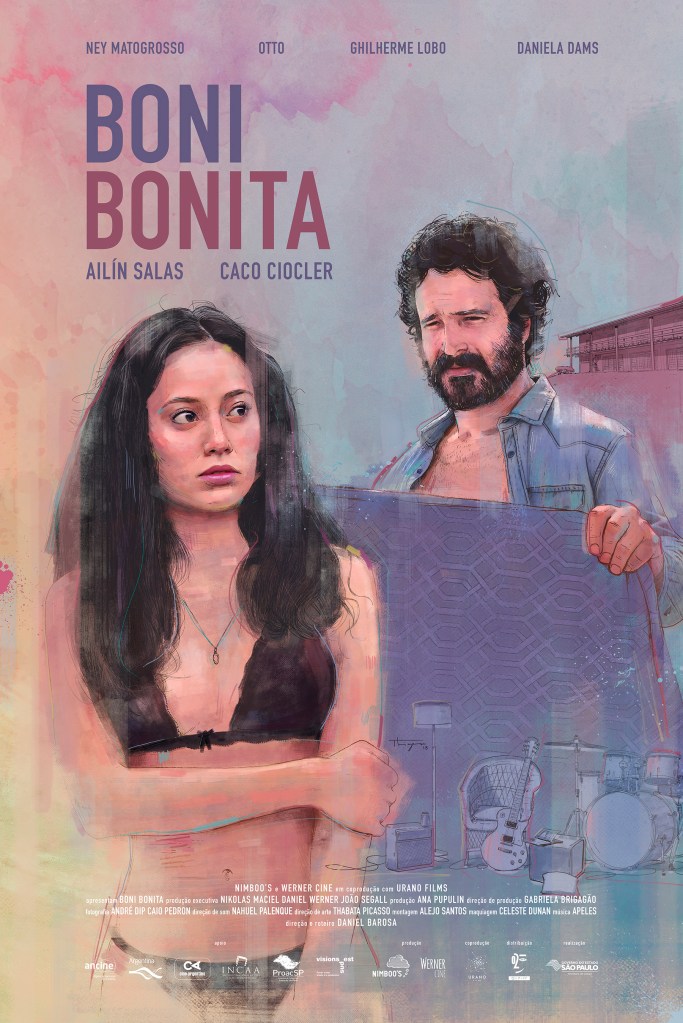
Slamdance: Boni Bonita

Boni Bonita, directed by Daniel Barosa, is a Brazilian-Argentine film, mostly in Portuguese, about a rebellious young woman and an aging musician. The story takes place over nine years, starting in 2007 and ending in 2016, and follows Beatriz (Ailin Salas) as she struggles with the loss of her mother, her complicated relationship with her father, self-harm and the musician who seems just out of her reach. Rogerio (Caco Ciocler), has his own struggles. He lives in the shadow of his grandfather’s musical success and has casual rendezvous with women as a way to avoid something more meaningful. Over the years Beatriz and Rogerio reunite at Rogerio’s summer home. The film explores what it means to come of age and also to go through a mid-life crisis.

The title is a reference to a song by classic Argentine singer Alberto Cortez. Rogerio plays the song for Beatriz and often calls her “Bonita”. Filmed over three years, Boni Bonita was shot in 16mm, super 16mm and digital. An inventive technique that gives the film a grainy, fuzzy appearance, as though we were watching filtered memories. According to the director Barosa, the story is based on his own experiences of the indie music scene of Sao Paolo Brazil.

I couldn’t engage with Boni Bonita no matter how hard I tried. I enjoyed the mixed media style and Ailin Salas’ performance in particular. The characters and the story didn’t draw me in and I couldn’t help but feel disconnected.

Boni Bonita is distributed by Nimboo’s Films and had its premiere at Slamdance 25 as part of the Narrative Feature Competition. It’s the only film from Latin America at the festival. Boni Bonita was a finalist for the Guioes, selected for the French Workshop Eave on Demand and a finalist for best original screenplay at the Havana Film Festival among other honors.

Dede

Set deep in the Caucus mountains during the Georgian Civil War, Dede stars Natia Vibliani as Dina, a young woman struggling against her family’s strict rules regarding marriage. She’s betrothed to David (Nukri Khachvani) but is in love with his friend Gegi (George Babluani). David and Gegi are great friends and David owes his life to Gegi ,who saved him in battle. When the two discover that they both love the same woman and that Dina only loves Gegi, David commits suicide. With David out of the way, it seems like Gegi and Dina can go on with their lives. They marry and have a boy, Mose. However, they face many trials and tribulations as Dina’s failure to fulfill her duty in marrying David creates animosity among her community. A string of tragic events turns Dina’s world upside down and brings a new man Girshel (Girshel Chelidze) into her life. Can Dina ever find happiness in an unforgiving community and an even more unforgiving landscape?

Dede was directed by Marian Khatchvani and written by Khatchvani along with Vladimer Katcharava and Irakli Solomonashvili. It was filmed on location in Svaneti, Georgia. Konstantin Esadze’s cinematography is absolutely stunning. There are breathtaking shots of the secluded village with the gorgeous backdrop of the mountains. I love the juxtaposition of the stunning beauty of the surrounding nature but the brutality of living in such a harsh climate. 


This is a quiet, unassuming film with a powerful message. It expertly portrays the cruelty of arranged marriages. When you take the humanity out of relationships and family building in the name of tradition, there are harsh consequences. And while Dina is the main victim of the many tragedies of the story, it’s the community who must learn the error of their ways. You get a sense of how traditions can be soul-crushing for those involved. 

Dede is available from Corinth Films on DVD and on Digital through Vimeo and Amazon Prime.

A Moment in the Reeds

A MOMENT IN THE REEDS Final Poster

“I never thought this would happen here.”

Set in the Finnish countryside, A Moment in the Reeds follows the story of Leevi (Janne Puustinen) a college student on summer break. He’s helping his father, Jouko (Mika Melender) renovate the family’s lakeside home. The have a strained relationship made worse by the death of Leevi’s mother. This project is an opportunity for the two to bond but unfortunately they can’t see eye-to-eye on most things. Jouko hires Tareq (Boodi Kabbani), an English-speaking Syrian immigrant who doesn’t understand a lick of Finnish. Leevi serves as translator between the two. When his father’s business takes him away from the project leaving the two behind, they bond and soon discover their undeniable attraction to each other. In the Finnish summer when the days are long and the weather is more forgiving, Leevi and Tareq spend every waking moment together in each others arms. The threat of Jouko finding out about their relationship and the realization that their lives will take them in different directions prevents them from fully opening up to each other. Will what Leevi and Tareq have last for more than just a few summer days?

A Moment in the Reeds was written, directed and edited by Mikko Makela. This is his featured debut and one of the first LGBTQ films to come from his homeland of Finland. This is a quiet story with a few moments of real intensity. It’s spare, raw and poetic. More is said with a look than with words. The cinematography style with a hand-held camera gives the film a more intimate vibe. There are only four actors in the film and the majority of screen time is devoted to Leevi and Tareq’s story. Not much happens in the plot. It’s more about the connection between two people and the struggle between giving into physical attraction and protecting your emotional state when you’re scared to be hurt. The film is God’s Own Country (2017) meets Call Me By Your Name (2017) set in Finland. Some may find it a bit too quiet but others will appreciate it’s more intimate and subdued tone.

A Moment in the Reeds is available on DVD, Blu-ray and Digital.

DOC NYC: Family in Transition

Final Poster_001

Transgender people do not exist in a vacuum. Not only does the transition mean a painful rebirth for the individual but its also a harbinger of big change for the people in their lives. And when there is a spouse and children to contend to, how will this major life shift affect them?

The Israeli documentary Family in Transition tells the story of the Tsuk family living in a conservative Jewish community in the coastal city of Nahariya. Amit and his wife Galit have been married 20 years and known each other for 27. They’re incredibly close bond deepens when Amit reveals to Galit that he is a woman and wants to transition. Galit and their four children are supportive of Amit as he transitions. We follow their journey from Amit’s birthday party, to daughter Agam’s Bat Mitzvah to Galit and Amit’s ceremony as they renew their vows and remarry as women. It’s a two year process from Amit’s revelation, to the hormone treatment, to the gender reassignment surgery in Thailand and to the wedding vows. This is a portrait of a beautiful marriage and a close knit family supporting their own through a difficult time.

But the Tsuk family’s story doesn’t end here. Something shifts for Galit when she feels taken for granted and can’t find the emotional balance in her marriage with Amit that she craves. You can only give so much of yourself before you’re going to need to take something back. This is where life for the Amit and Galit takes a sharp and unexpected turn. Their journey begs the question, who do you want to be?

Family in Transition was directed by Ofir Trainin and premiered at this year’s DOC NYC. This fascinating documentary is not afraid to tackle some harsh truths about gender dynamics within the family sphere. The sudden shift in the Tsuk’s journey was surprising and revelatory. Going into it in more detail would spoil the film for those unfamiliar with the story. Trainin had this to say about the film in the official director’s statement:

“The main goal of Family in Transition is to expose a unique family that can teach us all how to accept the difference in one another. The Tsuk family breaks social conventions and helps change what we though we knew about gender, partiy, parenthood and transgender issues… By embracing the different, I hope we can work towards creating a world where transgender people can live a normal life and be accepted by their community.”

Family in Transition will open in Los Angeles on November 16th and in New York on November 23rd.

I encourage you to read transgender film critic Danielle Solzman’s excellent review of this film.


JustWatch.com