Skip to content

TagFilm Festivals

Sundance: The Blazing World

Loosely inspired by  Margaret Cavendish’s novel, The Blazing World examines the long-term effects of trauma through a psychedelic lens. Margaret (Carlson Young), her mother Alice (Vinessa Shaw) and father Tom (Dermot Mulroney), are haunted by the early death of Margaret’s twin sister Elizabeth. Each deals with the trauma in their own self-destructive way. Margaret is suicidal and enters a dark place in her mind where she is followed by a mysterious man, Lained (Udo Kier), who lures her into an alternate world, a visualization of her trauma, where she must face multiple challenges in order to survive.

The Blazing World is an impressive directorial debut by actress Carlson Young who stars in the film and co-wrote the script with Pierce Brown. It’s a visual masterpiece and even if you are not sure what’s going on in the plot you’ll be dazzled by the intense and colorful imagery. The set design, color schemes and costumes are pure eye candy.  I particularly enjoyed Udo Kier’s performance as the creepy Lained. 

Some have criticized the film because how it approaches female trauma and its many film references. Trauma is unique to each individual and will not fill a mold based off of societal expectations. Also I really loved how this film seemed to be inspired by cinema. According to Young the film is heavily inspired by German Horror. I found references to Fritz Lang’s Destiny which really piqued my interest.

The Blazing World premiered at the virtual 2021 Sundance Film Festival as part of their Next series.

Sundance: The Dog Who Wouldn’t Be Quiet/El perro que no calla

This gentle poetic film follows the story of Sebastian (Daniel Katz), a young graphic designer making his way through life. His sweet dog misses him when he’s gone. Her cries annoy the neighbors Sebastian’s employers don’t want her around either. As time passes, Sebastian mourns the death of his dog, struggles to find steady work and becomes a new father. Then there is a new pandemic which causes humans to pass out if they stand up straight. In order to survive humans must crouch under 4 feet or wear an expensive bubble over their heads.

Directed by Ana Katz, The Dog Who Wouldn’t Be Quiet/El perro que no calla is a somber film that covers a lot of ground in just over an hour. It’s shot in black and white and the lead actor Katz offers a beautifully subdued performance. However, despite its best intentions the film falls flat offering the viewer little by way of substance. For dog lovers, the early scenes are really tough to watch. A couple poignant scenes are told through hand-drawn illustrations. I wish this would have been implemented more. I also had hoped that the unusual pandemic was a more substantial part of the film and would be explained. I couldn’t quite connect with the story or the main character expect for his genuine connection with his dog.

The Dog Who Wouldn’t Be Quiet/El perro que no calla premiered at the virtual 2021 Sundance Film Festival as part of the World Cinema Dramatic Competition.

AFI Fest: Wander Darkly

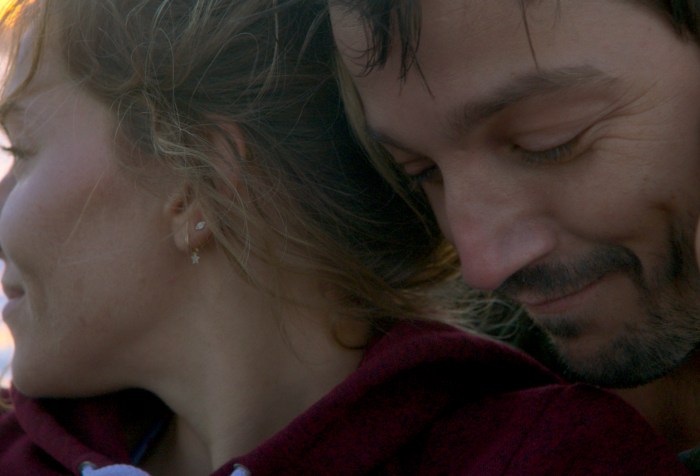
Adrienne (Sienna Miller) and Mateo (Diego Luna) are at an impasse in their relationship. The couple have settled down and had a baby but have ultimately grown to resent each other. After a tense interaction at a party,  Adrienne and Mateo are involved in a horrific car accident that inevitably changes their relationship forever.

It’s difficult to talk about Wander Darkly without giving away key elements of the plot that make the film so mesmerizing. Directed by Tara Miele, who was inspired by her own trauma to tell the story of Adrienne and Mateo, Wander Darkly is a gripping drama about trauma, love, gratitude and Miele calls “everyday magic.” The way film pivots back and forth from reality to memory, often combining the two, is astonishingly good. Miller and Luna breathe life into their characters in such a profound way. Wander Darkly is riveting and has easily become one of my favorite films of the year.

Wander Darkly was screened as part of the 2020 virtual AFI Fest. It is distributed by Lionsgate.

Double Exposure Investigative Film Festival: MLK/FBI

In February 2027, the Martin Luther King Jr. surveillance tapes recorded by the FBI will be unsealed and made available to the public. These tapes are the result of J. Edgar Hoover and the FBI’s extensive harassment of MLK. Hoover sought out sordid details of MLK’s extramarital affairs hoping that the information would ruin his public image and in turn weaken MLK’s leadership. What Hoover didn’t anticipate is that ultimately no one cared. The movement was full speed ahead and even one of the most powerful men in America couldn’t stop it.

Directed by Sam Pollard, MLK/FBI is both a compelling look into one of the darkest times in the history of the FBI and a brilliant portrait of a charismatic leader who was able to mobilize a community into peaceful action despite all the challenges that faced him. The documentary is comprised of photographs and archival footage as well as clips from newsreels and relevant classic movies. It was based on recently released documents made available by way of the Freedom of Information Act.

The talking heads narrate but are not seen until the end of the film. The narrators include Civil Rights leaders, historians and former FBI employees including former director James Comey. The greatest value of this documentary is the amount of quality archival footage of MLK himself. I have seen several documentaries about the Civil Rights movement but none  have included this much actual footage of MLK. The film is based on recently released documents made available by way of the Freedom of Information Act.

MLK/FBI is a priceless documentary that sheds light on the past and serves as a warning for the future.

MLK/FBI recently screened at the 2020 virtual Double Exposure Film Festival. It will be released by IFC in January 2021.

AFI Fest: The Lost Astronaut

Representation matters. When a young Edward Dwight Jr. saw a photo of an  African-American jet pilot in the newspaper, everything he dreamed about suddenly became a possibility. That one photo sparked something inside him and Dwight set out to achieve his dreams. He proved to be an excellent pilot and served as a captain in the Air Force. Dwight was selected as a NASA astronaut trainee by the Kennedy administration, the first African-American to be chosen. And while he was an exceptionally trained pilot, he never made it passed phase two of the training. It’s clear that the world wasn’t ready for a black astronaut. Dwight could have let this disappointment drag him down but instead he reinvented himself.

Directed by Ben Proudfoot, The Lost Astronaut is an intimate short documentary that profiles an extraordinary man. This 14 minute film is part of The New York Times series Almost Famous while profiles subjects in similar circumstances. The extreme close up on Dwight’s face as he recounts the story of his life makes the viewer feel like Dwight is an old friend that we care deeply about. What’s so exceptional about Captain Edward Dwight Jr.’s story is that his career happened during what the director refers to as “collision of the space race and the civil rights movement.” Had he been born a few decades earlier he may never have become a pilot. Had he been born a few decades later he might have become a NASA astronaut.

The Lost Astronaut was screened as part of the Meet the Press program for the 2020 virtual AFI Fest.

JustWatch.com