Skip to content

CategoryLatino/a

SXSW: Luchadoras

Ciudad Juarez, Mexico is one of the most dangerous cities in the world.  Between the years of 1993 and 2005, hundreds of women were brutally murdered, many discovered mutilated in the dessert and others never to be recovered. This violence against women in particular came from two dangerous forces: a drug cartel that wields incredible power still to this day and a deeply entrenched culture of machismo. Although the women of Ciudad Juarez live in constant fear of violence, they still manage to survive and thrive. For some, they find physical, emotional and mental strength as luchadoras: female Lucha Libre wrestlers known for wearing colorful costumes and masks in the ring.

Directed by Paola Calvo and Patrick Jasim, Luchadoras is a powerful documentary that follows three women wrestlers, Lady Candy, Baby Star and Mini Sirenita, as they transcend their circumstances and find strength through their sport. The resiliency of these women is astounding. A must-see for anyone seeking out feminist documentaries or who were inspired by stories like GLOW on Netflix.

Trigger warning: the film discusses violence against women. For those with hearing sensitivities like myself, there are several scenes in which the low battery chirp from a fire alarm can be heard.

Luchadoras had its world premiere at the virtual 2021 SXSW Film Festival.

Latin Noir

“In the 1970s, a new type of crime novel was created in Latin America. It was called Latin Noir.”

The 1970s was a tumultuous decade for many Latin American countries. Many were ruled by dictatorships and corruption infiltrated government, military and law enforcement. It was a time of violence, oppression and abuse of power. Those who spoke up against the powers at be fled for their safety and lived in exile. Writers from Mexico, Cuba, Peru, Argentina, Chile and beyond created their own genre of literature: latin noir/novela negra. These were urban narratives that explores violence, crime and power. It was a subversive type of literature; one that could criticize the dictatorships without being direct. The genre had its roots in crime fiction and film noir. These authors reinvented the genre offering readers thought-provoking literature.

“Violence, dictatorship, corruption, crime, embezzlement and economic woe are painful and present in all the countries of Latin America, creating widespread interest in detectives, guilt and justice.”

Director Andreas Apostolidis

Directed by Andreas Apostolidis, Latin Noir explores the sociopolitical environment that gave birth to this unique literary genre. Apostolidis and crew traveled to five Latin American countries to interview authors, journalists and other experts. Featured in the documentary are Leonardo Padura (Cuba), Luis Sepúlveda (Chile), Paco Ignacio Taibo II (Mexico), Santiago Roncagliolo (Peru) and Claudia Piñeiro (Argentina). Apostolidis sheds light on a lesser known aspect of Latin American history. I wish there had been more information about the books themselves. There is very little and I would have liked to learn more about the path to publication, the impact on readers and the legacy of this literary genre.

Latin Noir is an informative documentary that offers much needed context for a literary genre born out of turmoil.

Latin Noir had its world premiere at the Miami Film Festival

Sundance: The Dog Who Wouldn’t Be Quiet/El perro que no calla

This gentle poetic film follows the story of Sebastian (Daniel Katz), a young graphic designer making his way through life. His sweet dog misses him when he’s gone. Her cries annoy the neighbors Sebastian’s employers don’t want her around either. As time passes, Sebastian mourns the death of his dog, struggles to find steady work and becomes a new father. Then there is a new pandemic which causes humans to pass out if they stand up straight. In order to survive humans must crouch under 4 feet or wear an expensive bubble over their heads.

Directed by Ana Katz, The Dog Who Wouldn’t Be Quiet/El perro que no calla is a somber film that covers a lot of ground in just over an hour. It’s shot in black and white and the lead actor Katz offers a beautifully subdued performance. However, despite its best intentions the film falls flat offering the viewer little by way of substance. For dog lovers, the early scenes are really tough to watch. A couple poignant scenes are told through hand-drawn illustrations. I wish this would have been implemented more. I also had hoped that the unusual pandemic was a more substantial part of the film and would be explained. I couldn’t quite connect with the story or the main character expect for his genuine connection with his dog.

The Dog Who Wouldn’t Be Quiet/El perro que no calla premiered at the virtual 2021 Sundance Film Festival as part of the World Cinema Dramatic Competition.

AFI Fest: Wander Darkly

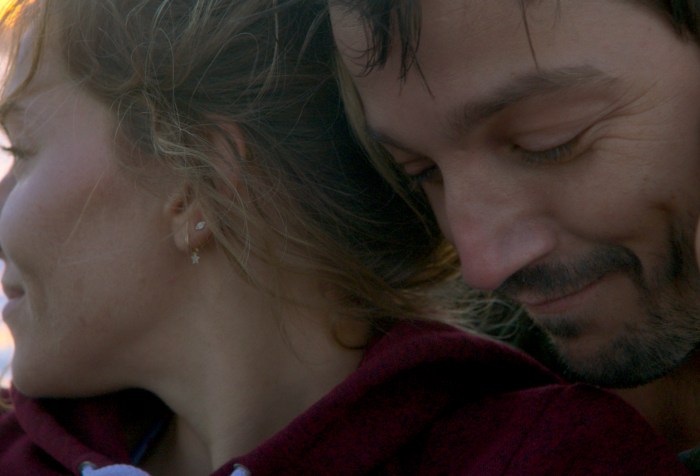
Adrienne (Sienna Miller) and Mateo (Diego Luna) are at an impasse in their relationship. The couple have settled down and had a baby but have ultimately grown to resent each other. After a tense interaction at a party,  Adrienne and Mateo are involved in a horrific car accident that inevitably changes their relationship forever.

It’s difficult to talk about Wander Darkly without giving away key elements of the plot that make the film so mesmerizing. Directed by Tara Miele, who was inspired by her own trauma to tell the story of Adrienne and Mateo, Wander Darkly is a gripping drama about trauma, love, gratitude and Miele calls “everyday magic.” The way film pivots back and forth from reality to memory, often combining the two, is astonishingly good. Miller and Luna breathe life into their characters in such a profound way. Wander Darkly is riveting and has easily become one of my favorite films of the year.

Wander Darkly was screened as part of the 2020 virtual AFI Fest. It is distributed by Lionsgate.

AFI Fest: The Intruder/ El Prófugo

“I feel like there’s someone outside asking me to open the window. And I know who it is.”

Something is wrong with Ines (Erica Rivas). After her vacation with boyfriend Leopoldo (Daniel Hendler) ends in trauma, Ines tries to go back to her normal, everyday life. She works as a voice actress dubbing horror films in Spanish and sings for a professional choir. Ines’ voice is her livelihood. However, a mysterious force is disrupting her work, adding strange noises to her recordings and affecting her otherwise dulcet singing voice. Another voice actress reveals to Ines what’s plaguing her: an intruder. First Ines hears the intruder, then she feels it and if she allows it, the intruder will take over her life. In the days following the trauma, Ines is possessed by the intruder who enters through her nightmares and makes her question what is reality and what is just a dream.

Directed by Natalia Meta, The Intruder/ El Prófugo is a bizarre psychological thriller about the real effects of trauma. I couldn’t quite make sense of this movie. I’m fascinated by the idea of “the intruder” and  the movie requires the audience to come up with their own interpretation of what it is and what it represents. My interpretation is that trauma is a parasitic host that preys on its victim. Things can escalate if the victim is not able to get the support they need to heal In this case the intruder literally grabs its victim by the throat which Ines’ most vulnerable spot since she uses her voice for her livelihood. Natalia Meta’s film is an adaptation of an even darker story, El mal menor by C.E. Feiling, which I’m interested in reading to see how it compares to the film. I do appreciate the fact that, while Meta could have turned this into a graphic horror film, she instead she made it into a female centric psychological drama, something I’m much more drawn to. The protagonist is played by Erica Rivas who delivers a brilliant performance.

The Intruder/El Prófugo was screened as part of the 2020 virtual AFI Fest.

JustWatch.com